 Verbale
Minutes of meeting (MOM) template: free, with an example
Minutes of meeting (MOM) are a short, factual written record of what was discussed, what was decided and who has to do what by when. Good meeting minutes fit on one page, are sent within a day, and let someone who wasn't there understand the outcome without asking a single question. Below is a free template you can copy, a filled example, and the mistakes that make most minutes useless.
What minutes of meeting are for
People often call them MOM, especially in Indian business English, and the purpose is the same everywhere. Minutes are not a transcript. They are not a diary of who said what. They exist to answer three questions afterwards:
- What did we decide?
- Who is doing what, and by when?
- What is still unresolved?
If your minutes answer those, they have done their job. Everything else is optional.
What to include in minutes of a meeting
The basics. Meeting title, date, time, place or call link, and who attended. Note who sent apologies. This is the "who was in the room" record, which matters later if anyone disputes what was agreed.
The agenda or purpose. One line is enough.
Discussion points, briefly. Only the context needed to understand a decision. Skip the back-and-forth.
Decisions. State each one as a plain sentence. "Pricing stays as it is; we review after the first month." Someone reading cold should be able to act on it.
Action items. Each needs three things: an owner, a task and a deadline. An action without an owner is a wish.
Open questions. What the meeting could not settle, and who will find out.
Next meeting. Date, if there is one.
Minutes of meeting template (copy and paste)
This version is written in Markdown. The #, ** and | marks turn into headings, bold text and a table in notes apps that support Markdown. In Word or an email they just show as symbols, so delete them or use the plain-text version below.
# Meeting minutes: [Title]

**Date:** [DD Month YYYY]
**Time:** [start] to [end]
**Place / link:** [location or call link]
**Attendees:** [names]
**Apologies:** [names, or "none"]
**Minutes by:** [name]

## Purpose
[One line: why we met.]

## Discussion
- [Topic 1: key points, in a sentence or two]
- [Topic 2: key points]

## Decisions
1. [Decision, as a full sentence]
2. [Decision]

## Action items
| Owner | Action | Due |
|-------|--------|-----|
| [Name] | [What they will do] | [Date] |
| [Name] | [What they will do] | [Date] |

## Open questions
- [Question] (who will find out: [name])

## Next meeting
[Date, time, and what it will cover]
Plain-text version, for Word, email or a chat message:
MEETING MINUTES: [Title]
Date: [DD Month YYYY]
Time: [start] to [end]
Place / link: [location or call link]
Attendees: [names]
Apologies: [names, or "none"]
Minutes by: [name]

PURPOSE
[One line: why we met.]

DISCUSSION
- [Topic 1: key points]
- [Topic 2: key points]

DECISIONS
1. [Decision, as a full sentence]
2. [Decision]

ACTION ITEMS (owner - action - due)
- [Name] - [What they will do] - [Date]
- [Name] - [What they will do] - [Date]

OPEN QUESTIONS
- [Question] (who will find out: [name])

NEXT MEETING
[Date, time, and what it will cover]
Minutes of meeting example
The same template, filled in for a short client call.
# Meeting minutes: Phased rollout call

**Date:** 22 September 2026
**Time:** 10:30 to 11:00
**Place / link:** Video call
**Attendees:** Asha (client), Rahul, Meera, Dan
**Apologies:** none
**Minutes by:** Meera

## Purpose
Agree how the new version reaches the client's users.

## Discussion
- The client wants a phased rollout rather than a single release.
- QA is not finished, so the original ship date is at risk.

## Decisions
1. Roll out in phases, starting at 10% of users.
2. Keep pricing as it is and review it after the first month.
3. Shipping moves to Thursday because QA is not done.

## Action items
| Owner | Action | Due |
|-------|--------|-----|
| Rahul | Send the updated plan to the client | Friday |
| Meera | Write the support help article | Before launch |
| Dan | Book a room for the demo recording | Monday |

## Open questions
- Which user groups go into the first 10%? (Asha to confirm by Wednesday)

## Next meeting
Monday, to record the demo.
Common mistakes
Writing it as a transcript. If your minutes run to five pages, nobody will read them. Summarise.
Vague actions. "Look into pricing" tells nobody what to do. "Rahul to send three pricing options by Friday" does.
No deadlines. Without a date, an action drifts. Always put one.
Sending them late. Memory fades within a day. Send minutes the same day if you can.
Recording opinions as decisions. If someone suggested something and nobody agreed, it is an open question, not a decision.
Skipping the open questions. Unresolved items are where the next meeting's agenda comes from.
Drafting minutes from a recording
Writing minutes by hand means you spend the meeting half-listening and half-typing. An alternative is to record, then draft from the recording and edit.
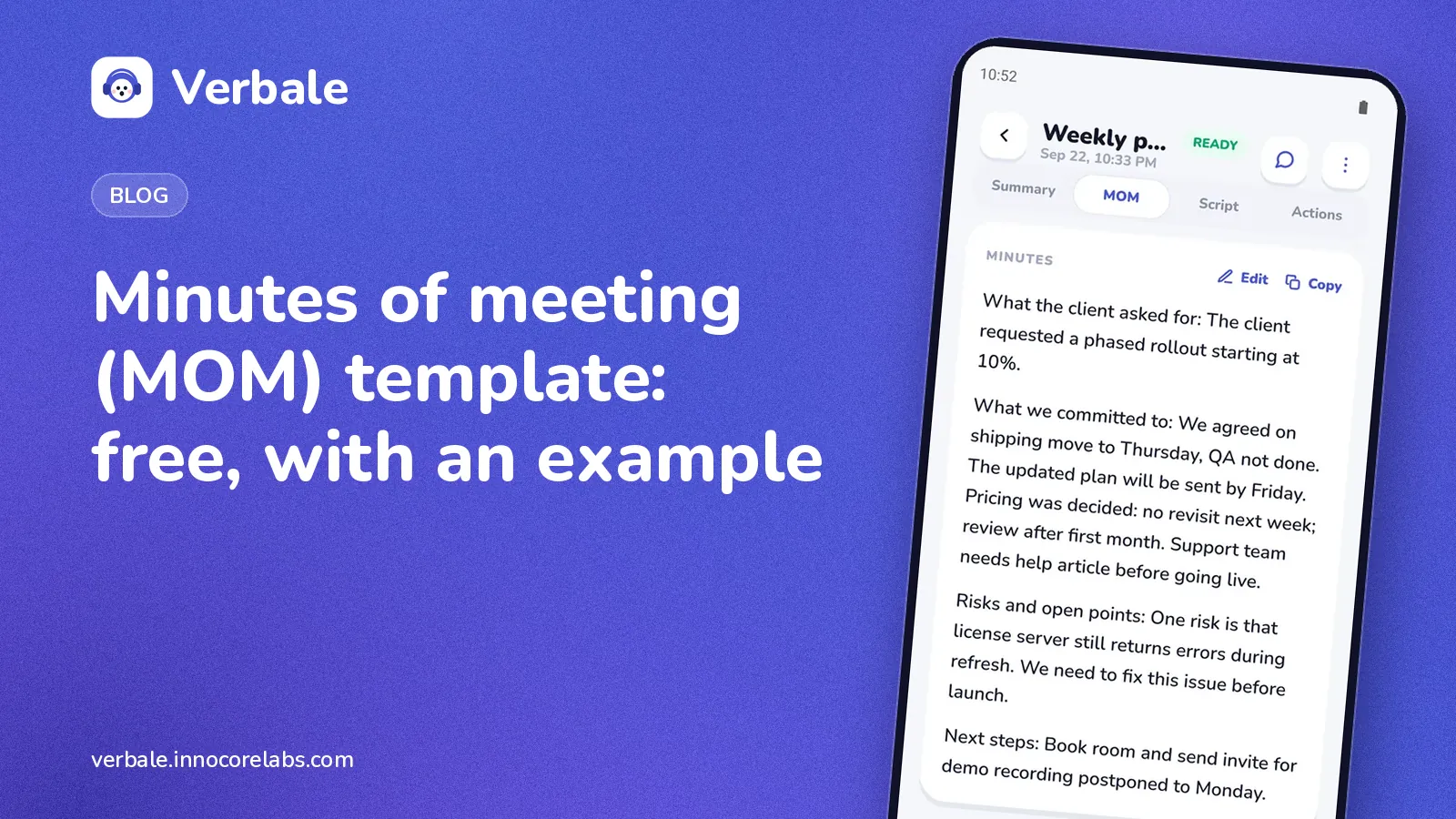
Verbale can draft these for you, on the phone. Decisions, action items and open questions each link back to the moment they were said, so you can tap one and hear the original words before you trust it. Pro writes the minutes in plain English, shaped to the meeting type: a stand-up reads differently from an interview.
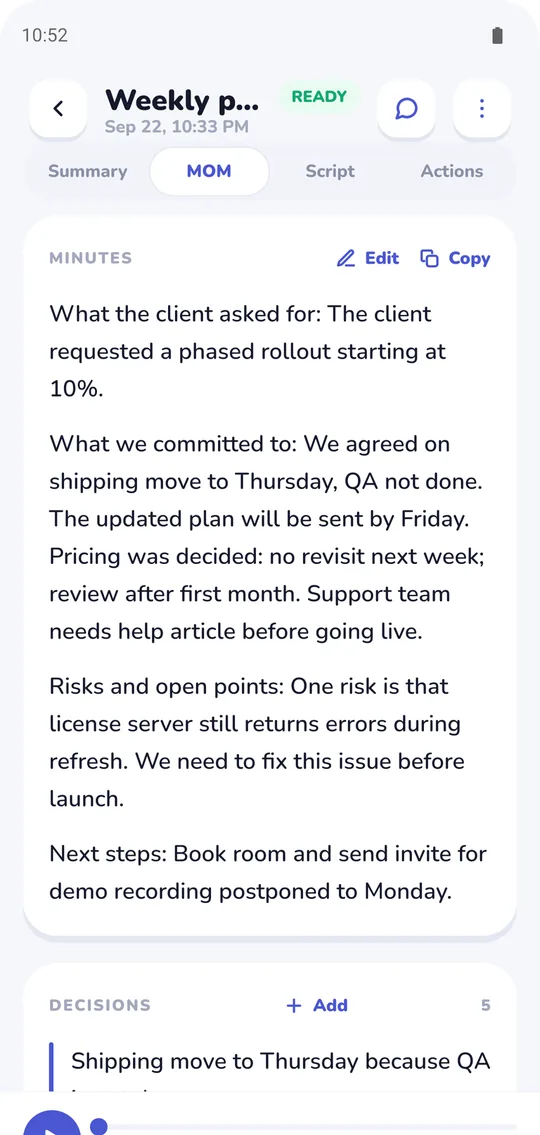
Minutes drafted from a recording, with a Copy button so they can go straight into an email.
The draft is a starting point. Read it, fix names and dates, and add anything that was meant rather than said. If you want the recording side done well first, see how to record a meeting on your phone. For the privacy reasoning behind keeping it all on the device, read why meeting notes should stay on your phone.
FAQ
What is the difference between minutes and a summary?
A summary says what a meeting was about. Minutes record the outcomes: decisions, owners, deadlines and open questions. A good set of minutes often includes a short summary at the top.
How long should minutes of a meeting be?
As short as they can be while answering what was decided, who does what by when, and what is unresolved. For an hour-long meeting, one page is a good target.
Who should write the minutes?
Whoever was asked to, and it should be agreed before the meeting. Rotating the job avoids it always falling on the same person. Recording the meeting makes it easier to write them accurately afterwards.
Can I get minutes written automatically from a recording?
Yes, tools exist that draft minutes from a recording. Whatever you use, check the draft against what was said before you send it, because automatic notes can miss context or get a name wrong.